Wednesday, 26 August 2015

Black in Bexhill on a recurring theme

Following on from my last post a recurring theme began to occur whereby I would drive to Bexhill, fail to see a Black Stork, and then return home. This occurred on consecutive days until Wednesday (19th) when I decided to stake out Little Common recreation ground (the home of Little Common Ramblers CC for those who are interested in such things) where there had been intermittent reports of Bexhill Black in flight. So it came to pass that at 09.55 the aforementioned juvenile Black Stork appearred from the local gardens and gained height over the cricket pitch before drifting off towards Sidley. Clearly there is a lot of Heron fodder available in Little Commons multitude of sub-urban gardens with Grey Herons dropping in periodically along with the Stork, which is still present at the time of writing and periodically perching on fences, by ponds, and in the road for the fortunate few...
Out on the levels the autumn hirundine gatherings are taking place with birds preparing to head south. On the 21st I watched 3 Hobby hawking dragons over Horse-eye, consuming them on the wing, and a Kingfisher was watched along the drain at Hankham. The main reason for visiting Hankham was to look for Small Red-eyed Damselflies which was successful with at least two males seen. Other dragonflies included Ruddy and Common Darters, Emperor, and Brown and Migrant Hawkers.
Continuing the insect theme the Hornet Hoverfly, or more correctly, Volucella zonaria, pictured right was in the garden on the same afternoon.
Mothing continues to provide interesting immigrants with the Scarce Bordered Straw pictured left found on my Tomato plants on the 24th. Other immigrants and moths of interest over the past week as follow: Swallow Prominent (15th), Common Carpet (17th), Bordered Straw, Dark Sword-grass, Dingy Footman, Hoary Footman, Peacock, Sharp-angled Peacock, Yellow-barred Brindle, and Yellow tail (20th), Gold Spot, Orange Swift, and Satin Wave (21st). Peak night was the 20th with 88 macros' of 31 species and 28 micros' of 12 species. Over the same nights two new micros' for the garden turned up in the form of Acleris variegana (17th) and Acleris laterana (21st), other bits and pieces included Cydia splendana (pictured above right) (20th) and Cydia amplana (21st).

And so to return to my opening theme of cricket, hence the reference to Little Common Ramblers, Sunday saw myself and middle child taking the trek to the Oval for an urn lifting experience to follow on from Edgbaston day one. My eldest daughter has been fortunate indeed in that her first live experience of ashes cricket was day one at Edgbaston, oh Jimmy Jimmy, and that she has not had to experience the eighteen years of hurt that both myself and Mr Paul Chapman, noted lister and mother extraordinaire had to put up with prior to my last urn lifting experience on the final day of the 2005 series. Regrettably aforementioned PC's rain dance (pic left) failed to get England out of jail despite filling up Justin Langers ditch, reprise "are you standing in a ditch" c2005, however any day you get to see the urn lifted is a good one! The cricket pictured below is a Speckled Bush-cricket found in the garden on the 12th that I have just got round to identifying, a somewhat tenuous series of links I know, but one that I like, better anyway than the Gooch, lbw, bowled Alderman I had in my younger days!


Sunday, 16 August 2015

The day of the Greenshank

It's been a great week on the moth front with the highlight being the Convolvulus Hawkmoth my eldest daughter found on my boxers which were hanging on the washing line on the 9th. This represents my 3rd record for the garden but is comfortably the earliest, and the freshest as the picture above demonstrates, with the others being in September 2005 and October 2006.
 The garden moth list has also had
two new macro additions this week in the form of the Webbs' Wainscot pictured left on the night of the 11th, and the Straw Underwing pictured right on the night of the 13th. Whilst the overall numbers remain down it seems that immigration is the best it has been for a few years, Small Mottled Willow, an immigrant I had not trapped before has now reached a total of 6 with a singleton on the night of the 5th and two on the night of the 13th. Another immigrant, Dark Sword-grass was trapped on the nights of the 5th and 9th with an unprecedented 6 on the 13th. New moths for the year list included the second Lunar Thorn for the garden on the 9th pictured below, along with Pale Mottled Willow on the night of the 5th, Blood Vein, Cabbage Moth, and Pebble Prominent on the 7th, Lychnis, Poplar Hawkmoth, and Yellow Shell on the 9th, Cypress Pug, and that harbinger of the autumn Setaceous Hebrew Character on the 11th, Copper Underwing, and finally Maidens Blush on the 13th. 
Micros' have been booming as well with new for the garden Calamatropha paludella (pictured below) on the night of the 5th, Epinotia nisella on the 9th, Galleria mellonella (Wax moth), and Ypsophola scabrella on the 11th, and Pyrausta purpularis on the 13th. Calamatropha paludella is a scarce moth of fens and marshes the larva of which feeds on Bulrush so perhaps it is not surprising one has found its way into the garden! The nights of the 11th and 13th yielded my first Cydia amplana of the year.
Out on the levels "Bexhill Black" was searched for but unfortunately not connected with, quite where this Black Stork gets too who knows? I trawled the area from Cooden Beach north to Hailsham on the 15th with no joy at all, perhaps he heads east to Filsham? Todays WEBS count was a step up on recent efforts with the recent rain having refreshed the flashes to such an extent that proper waders were present! In fact Down and Horse-eye were covered with them, relatively speaking that is, with 12 Greenshank, 1 Green Sandpiper, and 7 Snipe on Down, and a further 11 Greenshank, and 25 Snipe on Horse-eye. Raptors included another indicator of autumn with an immature male Merlin together with one of the semi-resident Marsh Harrier mooching around the dykes. The regular Red Fox was on Down and 3 Brown Hawkers were seen along White Dyke. Floral accompinent was provided on White Dyke by the Amphibious Bistort pictured above right.
Finally to a few other bits and pieces from the garden in the form of the Acorn Weevil pictured left which was frequenting the moth trap on the morning of the 14th and the fly Volucella inanis pictured below which was pottering around the garden on the 16th. All useful additions to the pan list along with the leaf hopper Iassus ianio which was also seen on the 14th. Keep smiling.

Wednesday, 5 August 2015

Its a jungle out there


Well its been a while in the making but the night of the 3rd saw my 300th macro species for the garden in the form of the Dark Spinach pictured right. Also on the 3rd my 100th micro species for the garden was trapped - Hypsopygia costalis or Gold Triangle - and my 101st - Dioryctria costalis. I am slowly getting to grips with the micros' now and know that if the conditions are calm and warm there are going to be plenty of them about so better get the pots lined up! Mothing has been pretty quiet over the past week with clear cold nights and a bright full moon resulting in only 22 moths of 8 species being trapped on the night of 27th July, truly appalling, but things have now picked up again with the 3rd producing a total of 104 moths of 40 species.
The weekend saw me wandering around Hankham and Manxey as well as Horse-eye and Down in pleasant enough weather. Bird wise things were very quiet with the only sign of return migration being a couple of Sand Martin mixed in with the Swallows at Rickney. Buzzards were much in evidence with birds recorded all across the levels and 4 together were soaring over Herstmonceux on the evening of the 3rd. Bird highlight though were the small party of Crossbills that chipped there way over the garden early on the 2nd as I was sorting through the moth trap. Dragons comprised Brown Hawker at Downash along with the commoner blue damsels on Hankham and Down but no sign of any Small Red-eyeds despite searching. The Water Plantain pictured right was out on Hankham on the morning of the 1st.
In fact the levels were so quiet on the 2nd that I resorted to pottering in the garden in an attempt to get the Pan species list up. Top of the garden potter was the fly Sicus ferrugineus pictured at the top of the page. First things first - this creature isn't winning any beauty competitions - it looks singularly unpleasant with its brown and yellow colouration and unusual posture. Secondly if you have buddhist leanings better hope you are not reincarnated as an insect, this particular fly is a parasitoid of Bumble-bees, all of which is rather unpleasant... Other additions to the garden pan list were the fly Neomiya viridescens, and hoverfly Eristalis pertinax, along with the spider Steatoda grossa pictured above. This species is one of the "False Widows" that cause periodic hysteria in the press and whilst it looks quite intimidating (for a beast about an inch across) its bite is unlikely to cause much more discomfort than a bee or wasp sting unless you are unfortunate enough to be allergic to the venom.


Saturday, 25 July 2015

Dog days pending moth landmarks

The dog days of July and August are well under way from a birding perspective with the July WEBS producing only Yellow Wagtail and a rather tatty female Marsh Harrier to brighten the notebook. Fortunately the quiet times for birding are the peak time for moths so the garden moth trap has been providing the action for the last couple of weeks even with the intermittent inclement weather putting a damper on things.
As this is only my second year taking in micros' they have been taking up a significant proportion of my time, mainly due to my short sightedness and inability to nab the little beasts before they head off to the borders. Nonetheless new species have been coming along thick and fast recently the best of which was the Spatalistis bifasciana (pictured above right) trapped on the night of the 14th. Other new micros since my last posting have been the bright yellow and brown Agapeta zoegana (18th), Clepsis consimilana (10th), Coleophera albidella (15th), Depressaria radella (Parsnip moth) (10th), Eudemis profundana (10th), Euzophera pinguis (pictured above left) (18th), Falsuncaria ruficiliana (17th), Nomophila noctuella (Rush veneer) (2 on the 23rd), Pammene fasciana (15th), and Synaphe punctalis (10th). Rush veneer is a moth that I must surely have overlooked in the past when I was only taking notice of the macros'!
On the macro front the best night in the period was the 14th with 104 moths of 35 species however there have been a number of notables (well for me at least) recorded over the period as follows: Small Mottled Willow (10th & 21st), Bordered Straw (9th), Dark Sword-grass (14th), Four-spotted Footman (21st), and Toadflax Brocade (15th). The Bordered Straw and Toadflax Brocades were both the third records this year for the garden and the Small Mottled Willows (the one trapped on the night of the 10th is pictured below) were the first records. All of this activity leaves me waiting for three insect landmarks! The garden macro list currently stands at 299, the garden micro list at 99, and the overall moth list therefore at 398, my money is on the micros reaching a hundred first but you never know....

Wednesday, 8 July 2015

Pan species listing and Bioabundance

The current edition of the excellent British wildlife has a short piece by Simon Barnes, in which he proposes a new term, Bioabundance, as a better subject for discussion than the rather trendy and glib biodiversity. He goes on to suggest that, as naturalists, what we should really be doing is moving away from the notion that as long as we have a diverse range of species, albeit many of them close to extinction, that the environment is ok, whereas what we should really be doing is pushing for an environment where species can be successful to the extent that they are present in large numbers in ecosystems that can support them. Now I don't agree with everything that Barnes' says, however as we went to the same school (hello Old Emanuels' everywhere) I have to say that in this case he makes an excellent argument. If you get the opportunity its' well worth a read as is the article on the re-introduction of the Short-haired Bumblebee co-authored by Jon Curson.
Anyway, this has rekindled a notion that has been in my head for a while relating to pan-listing, advocates of which suggest having a target of a thousand species in a square kilometre in a year, I am therefore targetting a thousand species in my small suburban garden. I suspect that this will take me significantly longer than a year, however I am certain it will be achievable once I get down to some of the groups that I have neglected over the years. One of the benefits of a moth trap for the amateur naturalist can be the presence of bycatch (although angry Hornets are not great!) and the Orange Ladybird pictured left was on the moth trap on the morning of the 4th and was a welcome addition to the garden list.
The good run of local birds continued on the 3rd with a Squacco present on the river Ouse at Southease. Needless to say the presence of a rare, and indeed my favorite white heron, resulted in a short car journey and walk in blistering sunshine to see the bird perched in reeds before flying to the bank of the main river. I was reminded on site that the last gettable Squacco in Sussex (that I also saw) was in 2000! On the patch the flashes have dried out though the Yellow Wags are still very active with both pairs on Down on the morning of the 4th. Also on the 4th the patch contained my first Common Emerald Damselfly of the year pictured above, along with numerous Variable Damsels, and whilst looking for Odonata I came across a plethora of the reed beetle Donacia versicolrea, 3 of which are pictured. On the mammal front a Brown Hare was walked up near the flashes, unfortunately it is difficult to avoid disturbing the Hares at this time of year as they are often close to the footpaths in knee high grass. They are far easier to observe in spring when they can often be watched feeding, washing, and occasionally boxing, at distance and downwind.
So finally to the moths which have surpassed expectations since my last posting with new macros' and micros' a plenty! Best night of the year yet numbers wise, was the 3rd of July with 49 macros' of 25 species and 38 micros' of 11 species, including a new macro species in the form of Common Lutestring. New macros' for the year on the 3rd were as follows: Common Wainscot, Double Square-spot, Fan-foot, Straw Dot, Sycamore, Treble Brown-spot, and White Ermine. The micros on the same night included 3 new species for the garden - Argyresthia cupressella (Cypress Tip moth) , Eucosma campoliliana (pictured above left), and Monopis crocicapitella, as well as first records for the year of Argyresthia goedartella, Endotricha flammealis, and Yponomeuta evonymella (Bird-cherry Ermine).
The night of the 1st though was better for quality with the 36 macros' of 23 species caught including new for the garden Scallop Shell (pictured above) and Beautiful Hook-tip (pictured left) as well as first records for the year of: Barred Yellow, Clouded Border, Common White Wave, Flame Shoulder, Green Pug, Green Silver-lines, Lackey, Lesser Broad-bordered Yellow Underwing, Miller, Single-dotted Wave, and Varied Coronet. Micros' on the 1st totalled 20 individuals of 10 species with Ancylis achatana, Ditula angustiorana (Red-barred Tortrix), Syncopacma taeniolella, and Zeiraphera isertana all being new for the garden! With Carpatolechia proximella also new for the garden on the night of the 29th of June things look like they are finally beginning to pick up in earnest.
And finally too flowers, which I am guilty of neglecting. The Flowering Rush pictured right is a particularly attractive and striking plant of the levels and is seemingly in more places this year than last, which cannot be a bad thing. The Cut-leaved Crane's-bill pictured left is a much smaller and daintier flower that I struggled to identify until JE gave me the heads up. Tame botanists are few and far between!

Sunday, 28 June 2015

Lazy hazy days and hedgerow brews


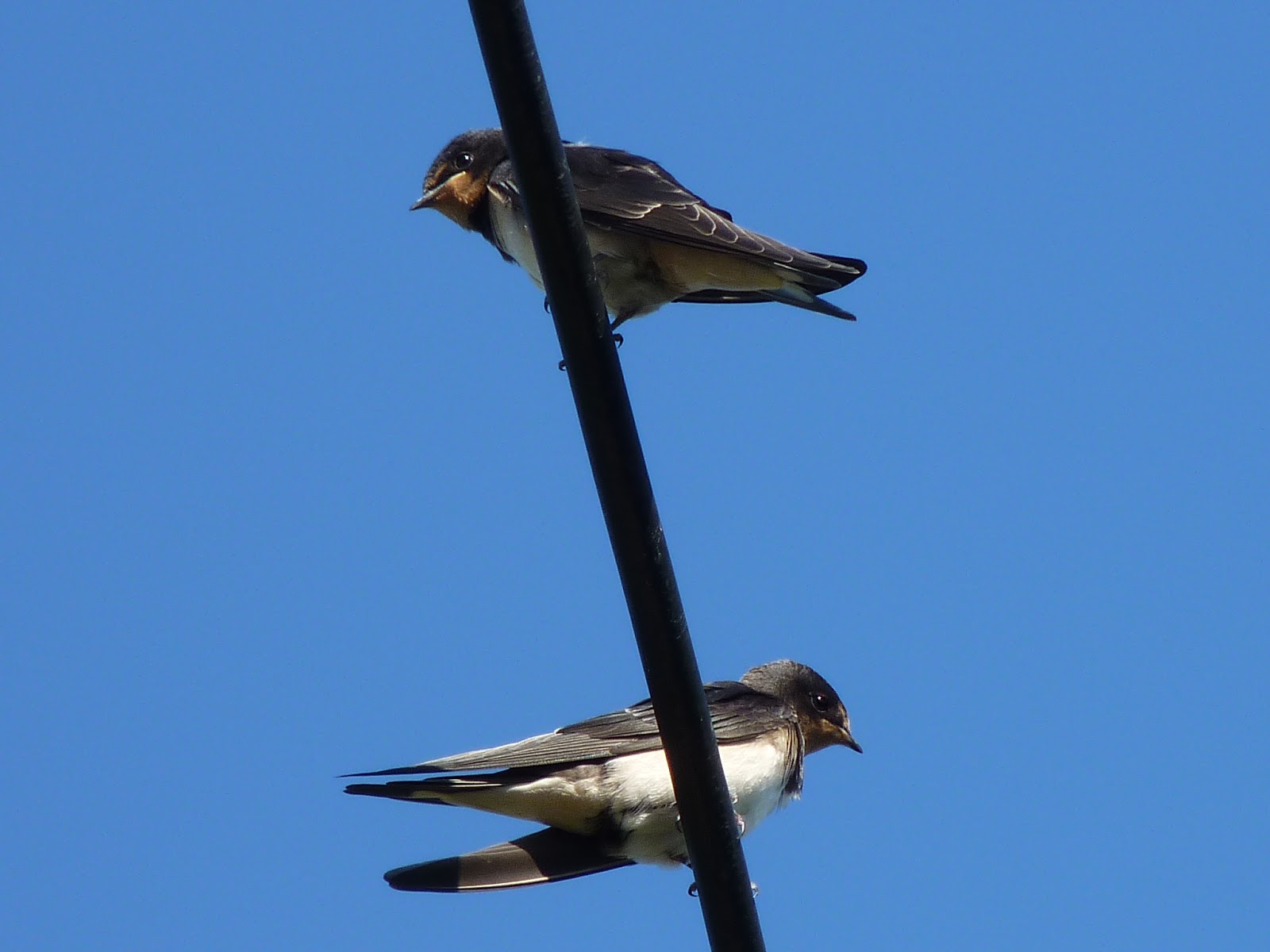
Out on the levels again this morning with a cycle round the patch in glorious weather. Perhaps because of the improved conditions a few fledglings were seen, in what has generally been a poor breeding year to date, including the Swallows pictured above which were part of a family of four, as was the Mute Swan cygnet pictured right at Rickney. Despite a post on the SOS website to the contrary, there are still Yellow Wagtails visible from the public rights of way across Down and Horse-eye levels, and the two pairs were still on their territories this morning (27th). Also this morning other residents on show included a pair of Hobby hawking dragons over Down, 2 pairs of Bullfinch in the lanes, singing Lesser Whitethroat at Chilley farm and White Dyke, Buzzard over Downash, and Redshank on Down Level.
The undoubted avian highlight of the week had to be the flock of 10 Bee-eater at Littleborne just off Glynde levels. Unfortunately I have no pics, as when the call came I was walking the dog in Abbots Wood and had made the cardinal error of not taking bins or camera (which I never do) as we had just got back from a long weekend in Norfolk! Consequently Bee-eater joins Red-throated Thrush on my list of birds seen through other peoples optics, so thanks to LP, JE, PJ, et al. Even without optics the sound and sight of a flock of Bee-eaters is quality so happy days all round.
Odonata were very much in evidence this morning with my first Black-tailed Skimmer (fem pictured above) and Brown Hawker for the year on Down Level. Small Tortoiseshell and Meadow Brown butterflies had also emerged with 30 and 28 respectively along White Dyke along with singles of Small heath and Painted Lady. Elsewhere my first Marbled White and Dark Green Fritillary for the year were seen at Birling Gap on the 26th.
So to the moths which remain very much sub par although picking up. My biggest problem at the moment is feline, with cat destruction of trap on the cards most nights - I am currently looking into solutions but don't hold out much hope. Highlight of the week was a new moth for the garden in the shape of the Scorched Wing pictured right - this takes the garden macro list to 295 so I am now firmly counting down to the big 300, hopefully later this year. Other new macros for the year as follow:
Heart and Club (16th), Clay Triple-lines , Common Footman, Cypress Carpet , Figure of Eighty, Privet Hawkmoth, Toadflax Brocade, & Uncertain (18th),  Buff Ermine, Common Swift, & Peppered Moth (unusually a dark variant) (22nd), Lime Hawkmoth (24th), Common Marbled Carpet, Small Elephant Hawkmoth, & Treble Brown-spot (25th)
The Toadflax Brocade captured on the 18th is pictured left and I caught a second individual on the night of the 24th. These are the 5th and 6th records for the garden of this striking shingle ridge specialist after a singleton in June 2010 and 3 individuals in May and June of 2012.
Micros' have also picked up with new species for the year as follow:
Crambus pascuella (16th), Agriphila straminella, Eudonea angustea, & Eudonea delunella (18th), Cydia pomonella (Codling moth), &Eudonia mercurella (24th).
Other bits and pieces of note include Flowering Rush in bloom on Down (27th), Badger at Arlington on the evening of the 24th, and during a nocturnal foray on the levels the same night a Reed Warbler still belting its song out on Horse-eye at midnight.
Finally those who know me well are aware that I am partial to a drop of refreshment every so often with hedgerow brews very high on my likes list. Mrs Leveller has kindly obliged with her first batch of Elderflower champagne for the year this weekend which is currently slipping down nicely. Cheers!

Wednesday, 17 June 2015

H is for holiday, Hudsonian Whimbrel, and a special surprise

I have finally managed to take some time off over the last week and as well as doing the patch have had the opportunity to spread my wings a little. Fortunately news of the Hudsonian Whimbrel at Pagham reached me while I was in the Chichester area so I managed to park easily at Church Norton with three other cars, it was a little more crowded when I left! Unfortunately due to my lack of preparedness for this first for Sussex I was dressed in Shorts and t-shirt with only my bins and bridge camera to keep out the stiff north-easterly and with a Whimbrel providing early confusion on sight things were quite tense for a period before the bird performed well off the spit enabling the assembling crowd to get to grips with its exciting plumage features... Seriously though a proper rarity and a top find, with all credit to the finders for being so prompt in getting the news out as I am not sure I would have fancied driving back later in the day!
Sundays WEBS count was much more mundane with the highlight being the resident Gadwall and Yellow Wags with the latter carrying huge mouthfuls of insects too hungry offspring. A single Marsh Harrier was the only other bird of any note, with the resident Red Fox, a few Variable damsels, and a Painted Lady providing a little extra interest.
Mothing has also picked up a little though this is relative with numbers still way down on any previous year. By way of interest a couple of new micros' were trapped in the week including the Celypha cespitana pictured right on the night of the 14th. The other new micro was Sitochroa palealis on the night of the 7th though unfortunately it was off before I could get a pic. On the macro front the highlight was a second Bordered Straw on the night of the 11th with new moths for the year as follow: Rustic (7th), Freyers' Pug, Turnip Moth, Large Yellow Underwing, & White-spotted Pug (11th), Dark Arches (13th),Bright-line Brown-eye & Rufous Minor (14th). As at the 14th totals were 108 macros' of 32 species and 21 micros' of 9 species from 29 nights trapping. For the same period last year I had trapped 330 macros' of 72 species and 77 micros' of 20 species from 35 nights trapping, even allowing for the short period when I was trapless these numbers indicate a very poor spring for most of our moths.
As for the special surprise, well that was in Blean Woods near Canterbury which I paid a short visit to on Monday the 8th. Whilst walking around some of the coppiced area I heard a rustle which curiosity made be investigate to reveal the little cracker pictured below. I have never seen Hazel Dormouse before so it was an unexpected treat to be able to watch this sleepy individual have a mooch along a bramble before climbing back into the coppiced Hazel where it belonged!